#1 Amazon Bestseller in Education
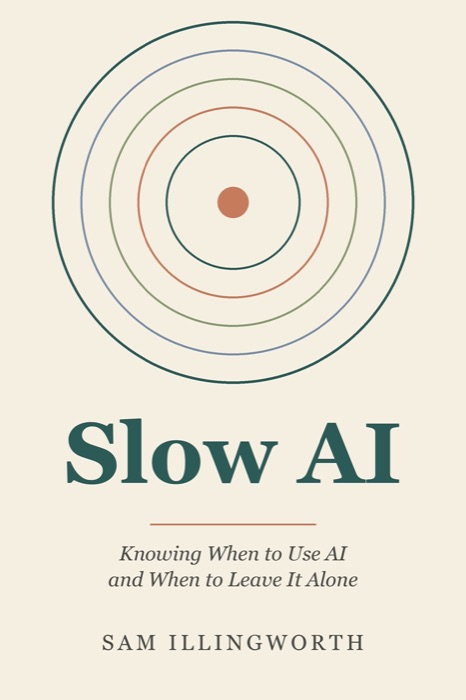
Slow AI: Knowing When to Use AI and When to Leave It Alone
The critical counterpoint to the books promising AI will save us. A short read on when AI helps, when it does not, and how to tell the difference, drawn from my research and from writing Slow AI for 23,000 readers.
Kindle and paperback.
What the book argues
Most writing about AI comes from people selling something. The utopians say it will fix education. The doomers say it will end the world. Both need you to believe the technology is more powerful than it is.
This book takes a third position. AI is a useful tool for some tasks and a poor one for many others, and the skill worth having is telling those apart in your own context. That skill is judgement, and it is teachable.
It is short on purpose. You can read it in an evening and use it the next morning.
Reviewed in Information Research
“Illingworth’s self-published little book … deals with the question of whether to use these tools at all, and when it may be better to put them aside.”
Professor Thomas D. Wilson, founding editor of Information Research and Professor Emeritus at the University of Borås, reviewed Slow AI in volume 31, issue 3, October 2026. Read the review.
Who it is for
- Teachers and lecturers being told to put AI into their teaching, with no evidence offered and no time to evaluate it.
- Researchers and professionals who want to use these tools without handing over the part of the work that is theirs.
- Leaders making procurement decisions they will be accountable for.
- Anyone tired of being told that AI is either salvation or apocalypse.
Free download · CC BY 4.0
A 60-minute workshop, ready to teach
Two pages. A full lesson plan for one session with students: three learning outcomes to paste into your own paperwork, the book’s four tests set out as a table for the board, a minute by minute run of the hour, and the specimen text the students pull apart. The only preparation is reading two chapters.
It runs with staff instead of students, and the three changes are on the sheet. Edit it, cut it, translate it, put your own logo on it. The only condition is that the attribution line stays.
Getting copies into an institution
The paperback is £7.99 in the UK, $9.99 in the US, and €9.99 across the EU, so twelve copies for a teaching team comes to £95.88. Order it through whichever supplier you already use: it is in the trade supply chain on ISBN 9798186576105, so Gardners, Askews and Holts, GOBI and any other Ingram supplied wholesaler can raise it against a purchase order and invoice your department.
Want to read it first? Ask me for an inspection copy. An electronic edition for library licensing is being set up for January 2027.
Other books
If you are after a wider reading list rather than my own titles, I keep an annotated one: what to read about AI and education.
I have written ten. These are the ones people ask about most.
GenAI in Higher Education: Redefining Teaching and Learning
Bloomsbury, 2026. The four pillars of student-centeredness, trust, relevance, and agency, worked through for institutions.
Effective Science Communication
IOP Publishing, third edition 2024. A practical handbook for researchers who need to be understood.
Poetry and Pedagogy in Higher Education
Policy Press, 2024. Creative practice as a serious method for teaching and research.
A Sonnet to Science
Manchester University Press, 2019. Six scientists who were also poets, and what that combination made possible.
Questions about the book
What the book argues, what critical AI literacy means, and how to get copies into an institution.
What is Slow AI the book about?
Slow AI: Knowing When to Use AI and When to Leave It Alone argues that the useful skill with AI is judgement: knowing which tasks these tools belong in and which they do not. It is 99 pages, reads in about two hours, and takes a third position against both the people who say AI will fix education and the people who say it will end the world.
What is critical AI literacy, and how does this book teach it?
Critical AI literacy is the judgement to know when AI is useful and when it is not, which goes further than writing a good prompt. The book teaches it through four tests you apply to a task before reaching for a tool. Is the task bounded, so it has edges? Is there a human downstream who is attentive, qualified, and inside the decision? Is the comparison honest, judging the system against what is actually available at that moment? And does the thinking stay yours? Chapter 2 makes the case for good AI use early on purpose, because refusing AI where those four tests pass is its own failure of judgement.
Can I use Slow AI with a class or a teaching team?
Yes. There is a free two-page lesson plan for a 60 minute workshop, ready to deliver. It carries three learning outcomes you can paste into your own paperwork, the four tests set out as a table for the board, a minute by minute run of the hour, the specimen text the students work on, and the three changes for running the same session with staff instead. The only preparation is reading two chapters. It is published under a CC BY 4.0 licence, so you can edit it, cut it, translate it, and add your own logo. Download it from samillingworth.com/book.
How much does Slow AI cost, and how do institutions order copies?
The paperback is £7.99 in the UK, $9.99 in the US, and €9.99 across the EU, so twelve copies for a teaching team comes to £95.88 or $119.88. Order it through whichever supplier you already use: it is in the trade supply chain on ISBN 9798186576105, so Gardners, Askews and Holts, GOBI and any other Ingram supplied wholesaler can raise it against a purchase order and invoice a department in the usual way.
Can I get an inspection copy or a review copy?
Email sam.illingworth@gmail.com and ask for an inspection copy.
Is there an edition libraries can license?
An electronic edition for library licensing is being set up for January 2027. The paperback is already orderable through the trade supply chain on ISBN 9798186576105. Email sam.illingworth@gmail.com to be told when the electronic edition is available.
Who is Slow AI for?
Teachers and lecturers being told to put AI into their teaching with no evidence offered and no time to evaluate it; researchers and professionals who want to use these tools without handing over the part of the work that is theirs; leaders making procurement decisions they will be accountable for; and anyone tired of being told that AI is either salvation or apocalypse.
Has Slow AI been reviewed, and what did the review say?
Professor Thomas D. Wilson, founding editor of Information Research and Professor Emeritus at the University of Borås, reviewed it in volume 31, issue 3, pages 548 to 549, October 2026, DOI 10.47989/ir31367985. He wrote that the book "deals with the question of whether to use these tools at all, and when it may be better to put them aside". It is also a #1 Amazon Bestseller in Education.
Read the writing it came from
Slow AI is a newsletter on critical AI literacy, free to read, published two to three times a week.
Read Slow AI, free